
Reform of Mexico’s Federal Administrative Litigation Procedure Act: Eight Key Changes to Litigation before the TFJA
As a general rule, the reform entered into force on June 10, 2026. However, two of its key components take effect at later dates: electronic appearances by respondent authorities and third parties in proceedings conducted under the traditional procedure will begin on December 6, 2026, and the Court’s new maximum procedural time limits will become enforceable as of February 4, 2027. Below, we highlight the amendments with the greatest practical significance for companies and individuals that litigate, or may find themselves litigating, before the TFJA.
1. Mandatory maximum time limits for the Court
The reform’s most significant structural change is the introduction of express deadlines for Court actions that historically had no statutory time limit. New Article 6 Bis requires any order or ruling on a filing to be issued within no more than five days. Along the same lines, new Articles 17 Bis and 21 Bis establish a five-day period for ruling on the admission or rejection of the claim, any amended claim and the corresponding responses, once any deficiencies identified by the Court have been cured.
Decision-making timeframes are also shortened: the Magistrate assigned to the case must prepare a draft judgment within thirty days after the evidentiary stage closes, and the Chamber must render judgment within forty-five days after such closing. An unjustified and repeated failure to prepare the draft judgment or render the judgment within these periods may give rise to administrative liability under the General Law of Administrative Responsibilities. In addition, the statutory mechanism for expediting adjudication (excitativa de justicia) is strengthened through specific time limits and the possibility of replacing adjudicators who fail to comply with the decision-making obligations established by law.
These maximum time limits will become enforceable 240 calendar days after publication of the Decree, a period granted to the Court to make the necessary operational adjustments. If the TFJA has the operational capacity to absorb the additional workload, overall resolution times should decrease noticeably; in any event, litigants will have objective benchmarks to press for procedural progress in their cases.
2. Expanded summary proceedings
The reform doubles the monetary threshold for summary proceedings, from fifteen to thirty times the annual value of the Unit of Measurement and Update (Unidad de Medida y Actualización, or UMA), which in practice expands the universe of cases that may proceed under this expedited track. The reform also introduces a particularly relevant new ground for summary proceedings: decisions on tax refund applications arising from credit balances or payments of amounts not legally due may be challenged in summary proceedings, provided that the amount in dispute does not exceed the applicable threshold, equivalent in 2026 to approximately MXN $1.28 million. This change may be particularly significant for taxpayers because it allows lower-value disputes of this type to proceed under considerably shorter procedural deadlines.
The Decree also provides that a final judgment in summary proceedings must be issued within a maximum of six months from the admission of the claim. This period is tolled by incidental proceedings, appeals, litigation or other proceedings that prevent the issuance of the final judgment.
3. Digitalization: hybrid case files and corporate electronic signatures
The reform further advances the transition to digital litigation. Its principal innovation is a hybrid model: even where the claimant has chosen the traditional procedure, the respondent authority and third parties may appear and file submissions through the Online Justice System without filing service copies; the Chamber will print and certify those electronic records for inclusion in the physical case file. This arrangement will become operational 180 calendar days after publication of the Decree. In addition, when a government authority is the claimant, the claim must in all cases be filed online.
Legal entities may also file claims and other submissions using their own advanced electronic signature, without relying on the electronic signature of their legal representative. Where a filing is made through the Online Justice System using the legal entity’s own advanced electronic signature, it will be presumed, unless proven otherwise, to have been made by the person serving as sole director or chair of the board of directors at the time of filing. This presumption requires companies to maintain strict internal controls over the custody and use of their digital certificates.
4. Stay of enforcement of the challenged act: removal of the difficult-to-repair harm requirement
For stays of enforcement of challenged administrative acts, the reform removes the Article 28 requirement that the harm or loss caused to the applicant be difficult to repair. At the same time, the Act introduces express circumstances in which a stay is deemed to harm the public interest or contravene public policy: where it would allow activities or services requiring a federal permit, authorization or concession to continue without one, or where it would allow conduct constituting an infringement or criminal offense under the legislation from which the challenged decision arises to be carried out or continued. These issues are likely to become key points of contention in interim relief proceedings, particularly in regulated sectors.
The stay procedure is also accelerated through expedited deadlines: a request for a provisional stay must be ruled on within twenty-four hours; the respondent authority must submit its report within forty-eight hours; and the ruling on the definitive stay must be issued within the following five days. Separately, for the other interim measures governed by Article 25, any security accepted by the Court must be provided within three days; otherwise, the measure will cease to have effect. This requires parties to anticipate the logistics of bonds or other forms of security. Both interim measures and definitive stay orders may be modified or revoked upon supervening events before a final judgment is issued.
5. Enforcement of judgments
The reform seeks to address one of the recurring challenges of administrative litigation: non-compliance by authorities with Court judgments. Coercive fines for unjustified non-compliance are increased to a range of 300 to 1,000 times the UMA and may be imposed successively. Persistent non-compliance may be escalated to the recalcitrant authority’s hierarchical superior and may result in a referral to the relevant internal control body to determine liability. Where the nature of the challenged act permits, the Court may even appoint a judicial officer to directly enforce the judgment.
In addition, where compliance with a judgment entails the exercise or enjoyment of a right and the authority fails to comply within the statutory period, the beneficiary of the judgment will be entitled to compensation determined in ancillary proceedings, taking into account the time elapsed and the losses caused by the non-compliance.
6. Tax review appeals
For review appeals that authorities may file against certain TFJA rulings and judgments, the reform raises the monetary threshold to 27,000 times the UMA, equivalent in 2026 to approximately MXN $3.17 million. In principle, this reduces the universe of judgments favorable to private parties that authorities may challenge before the Collegiate Circuit Courts solely on the basis of the amount in dispute. In addition, for certain tax and foreign trade matters covered by Article 63, the reform expressly provides for review where the challenged act is annulled on formal or procedural grounds, provided that the applicable monetary threshold is exceeded. This adjustment may broaden the universe of formal or procedural annulment judgments subject to review in higher-value matters and, in practice, lengthen the time required for a decision to become final.
7. New obligations and sanctions for litigants
To promote procedural efficiency, Article 7 Bis authorizes the Court, after prior warning, to impose fines ranging from 100 to 1,500 times the UMA for filing manifestly frivolous and inadmissible claims, appeals or submissions. Separately, a manifestly inadmissible statutory complaint (queja) is punishable by a fine of 250 to 600 times the UMA. These powers will require greater technical rigor in drafting submissions and a candid assessment of the viability of each available remedy.
8. Practical implications and recommendations
The reform seeks to streamline federal administrative litigation through shorter procedural deadlines, greater reliance on digital tools and new rules designed to accelerate both the issuance and enforcement of judgments. Its practical effectiveness will depend, to a significant extent, on the Court’s operational capacity to implement these changes and address the existing backlog.
At this stage, we recommend that our clients: first, update internal deadline controls to reflect that notices published in the Judicial Bulletin will take effect on the second business day following publication; second, review custody and use policies for corporate advanced electronic signatures in light of the legal presumption applicable to online filings made with a company’s own signature; third, revisit stay and interim-relief strategies and anticipate any required security; fourth, assess whether summary proceedings are likely to apply in mid-value disputes and certain tax refund denials, given the resulting compression of deadlines for evidence, amended claims and other procedural steps; and fifth, apply heightened technical rigor to all filings in light of the Court’s new sanctioning powers.
For pending matters, the temporal application of each amendment should be assessed on a case-by-case basis, taking into account the date on which the proceedings commenced, the current procedural stage and the transitional regime applicable to the particular provision.
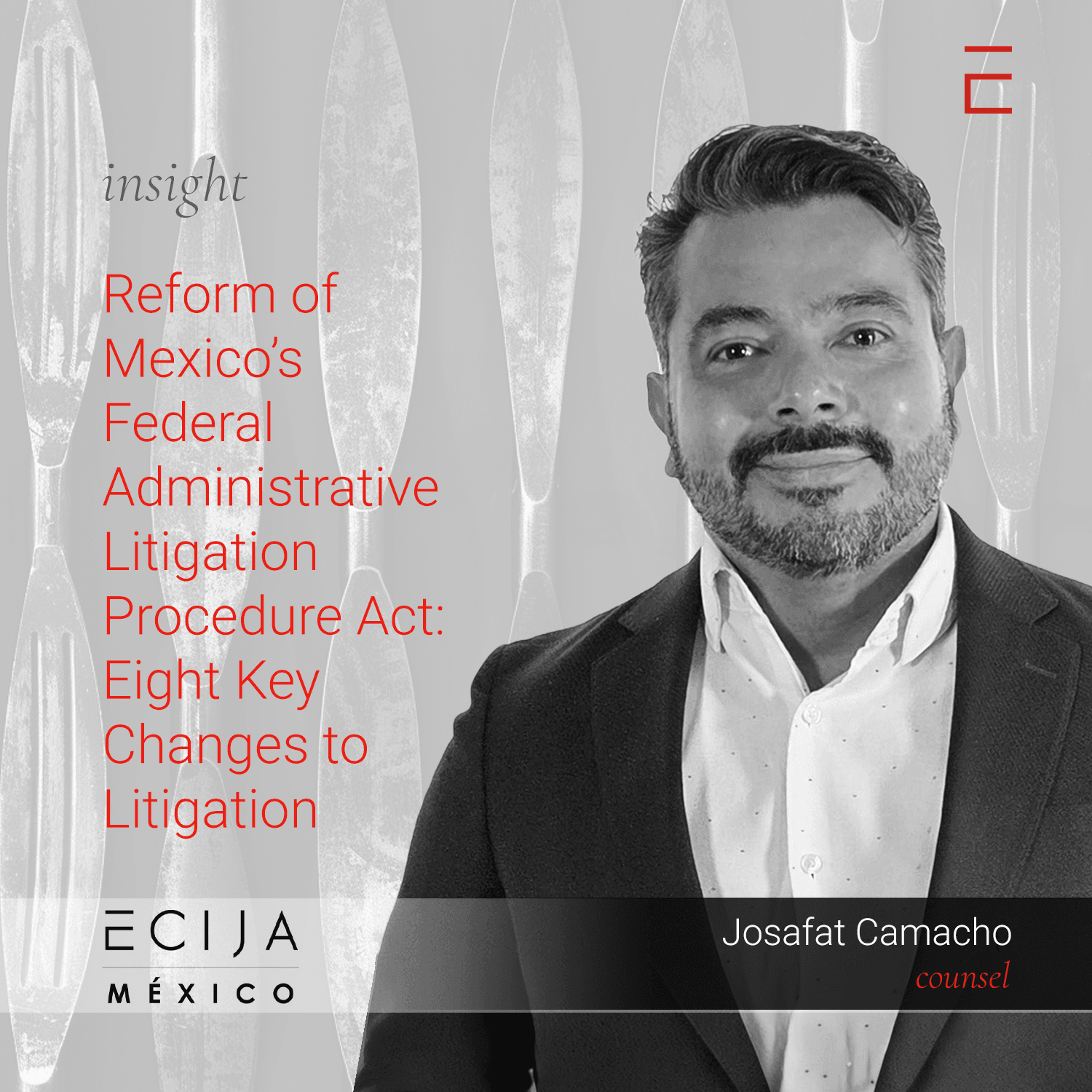
This article was prepared by Josafat Camacho, Partner and Head of the Tax Practice at ECIJA Mexico, drawing on his experience in tax and administrative litigation to analyze the key changes introduced by the reform and their practical implications for taxpayers.
